Showing posts with label Really really deep thoughts. Show all posts

18 January 2020

Divine Nature and the Book of Mormon: Part 0


“I have inherited divine qualities, which I will strive to develop.”

These are the words to help describe the purpose of the value Divine Nature in the Personal Progress program of The Church of Jesus Christ of Latter-day Saints. The emphasis throughout the whole program is on goal-setting, developing, and growth in a number of areas—“divine nature” being one of them.

Divine Nature is the category that I have always had the hardest time with. It’s part of a very complicated relationship I have with gender roles and what aspects of gender roles are actually a part of God’s divine plan for us and what aspects are just culture. There’s a lot that could be said on that, but I’m not going to delve into that.

Instead, I will tell you of the “wrestle which I had before God” (Enos 1:2). Or really, I will tell you how I decided to try to understand divine nature better.

To try to learn more about divine nature and what attributes and qualities we have inherited from our Heavenly Parents, I decided to re-read the Book of Mormon last Oct/Nov/Dec with a sole focus on seeking out qualities of divine nature and its examples in the scripture.

The process, honestly, was illuminating. I saw so many attributes that I would not have noticed before, but when I pondered and really asked the question, “Does this count as a godly quality that we have gained by being children of a Heavenly Father and Mother?” the Spirit said, “Yes.”

I kept a list, and it grew a little larger than I expected (as you will see). And then I tried to organize and sort them so that I could really look at and see them in myself and others.

Do I think we all have these traits equally? Of course not. For example, I feel like I lack a lot of the natural talent for nurturing and motherhood that some women seem to have in spades. But I think all of these traits are seeds that can be planted, if we choose, and that can grow into powerful traits that manifest the Divine Nature in all of us.

Because I found so many, I’ll be posting them in batches over the next few weeks. I’ve tried to categorize them, as I said, but obviously this is neither a comprehensive list nor a perfect one. This is just the way I’ve seen it as I’ve studied over the last few months.

And now, without further ado, Part 1!

06 January 2016

Other Blogs Recap


Once again, I have been not writing here forever. And I’ve been writing at my other blogs only slightly more. Sigh. I am once again having to reevaluate what I really want from this blog and what its purpose is. It’s sort of an ongoing thing. In the meantime, let’s cut out all the angst and move straight to the blog post, in which I direct you to a whole bunch of other blog posts over at MMW and Callooh Callay Callay (seriously, I’m recapping favorites from the past two years, so it’s a bunch). Just in case you missed all my riveting words there.

I tried cutting some of these out, because it’s really far too many links for anyone who doesn’t have wacky, crazy-long attention abilities, but these are all things I would have shared here if I hadn’t shared on the other blogs. They are all personal and meaningful to me at least. So please feel free to pick and choose. Or don’t read any of them at all, but then still post a comment here saying something like, “Oh, Jeanna. You are so magical. Pretty much your every word has changed my life. Thank you for being so practically perfect in every way. Sincerely, Your Biggest Fan.”


So, without further ado (and in reverse chronological order) . . .

In Which I Brag (Just a Little). Where I talk briefly about the writing project that I did for my and Brice’s foos and share my little happy dancing over how it turned out.

Acts of God. Really, if you only read one, probably read this one. It’s where I talk a little more about this pregnancy.

Was It You? Also, you should read this one. It’s where I announced this pregnancy. Also, it’s a true story.

Author and Finisher, A Houseful of Marshmallows, InfinityTimes Infinity. A number of my thoughts from reading and thinking about the scriptures and trying to apply them to my life.

The Elizabeth Bennets. Okay, you can actually probably skip this one. I only included it as a favorite because I enjoyed my own footnotes and also because I made fun of pretty much every Austen novel (even though I love Austen).

She Was Good at Apologies. Musings on being an imperfect mom and what I hope my children learn from me.

A Thought on Pain. How we can perhaps look at pain differently.

You’d Be Surprised. How sometimes we really just have to open our mouths about the experiences we’re having—we’re rarely alone, and there are often lots of people out there who care about us and want to help.

PPD and Me. Talking about some of my postpartum days after Koa was born.

Half a Talent. How we really shouldn’t compare ourselves to others—especially the sheep-raising, farming types.

The Killer What If? Life rarely gives us only one opportunity for something. If you miss an opportunity, move on and try to be ready for the next.

Perspective Shift. What I learned from having our house broken into.


31 July 2014

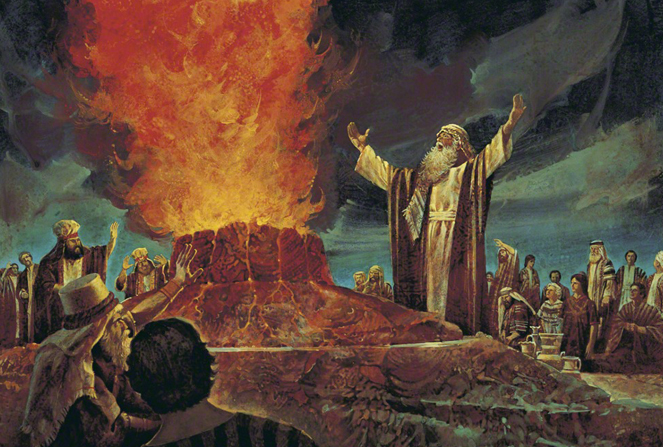
After the Fire

From lds.org. Also, I know it's not the portrayal
of the events I discuss, but it's all I've got. :)
After Addra was born, I really struggled emotionally for quite a long while. Looking back, I was probably (definitely) bordering on PPD (if not officially over the border)—but I hid it well enough that I was sort of getting by. In the wake of a new baby, I have felt like I need to do all I can to be better off this time than last. So I’ve been perhaps more receptive than usual to new interpretations of scriptures. It is in this state that I reread the story of Elijah and the still, small voice last week. While the part that we usually read is still beautiful and powerful, I was struck by the verses before and after the famous story (in 1 Kings 19, if you’re reading along). I don’t think this is any definitive interpretation of the story; it’s just the one that makes sense to me right now. I think that’s the great thing about stories and scripture stories in particular—they can reveal different things at different times

In this time period, Elijah is struggling, depressed. He is in hiding, his preaching has only earned him enemies, and he is watching the people he loves destroy themselves by wickedness. So I suspect that when he lies down and asks for death, he doesn’t do it lightly.

An angel comes and tells him to “arise and eat.” And sitting before him, without any effort of his own, is food and drink. This is especially poignant to me right now because after Koa was born, we were so blessed for many days in a row to find food appearing repeatedly on our doorstep, over and over, until our fridge could barely handle the leftovers. Friends and ward members fed my family during a time when what we needed most was rest and sustenance. We did nothing to receive it; it was a tiny but beautiful miracle to us.

Elijah eats, drinks, and rests. Then the angel gives him food and drink again because the journey set out before him is “too great.” And Elijah eats and drinks and goes “in the strength of that meat forty days and forty nights” until he gets to Horeb, to commune with God.

I love the beauty of this—Elijah is sustained in his long journey, his struggle. Doesn’t the journey sometimes seem very, very long? But are we not sometimes sustained in that journey by gifts freely given?

So when Elijah arrives at a cave at Horeb, the Lord asks him what he’s doing there, and this is Elijah’s response:

“I have been very jealous for the Lord God of hosts: for the children of Israel have forsaken thy covenant, thrown down thine altars, and slain thy prophets with the sword; and I, even I only, am left; and they seek my life, to take it away.” (v. 10)

To me, this feels exhausted, lonely, perhaps questioning his mission: “What’s the point? Nothing I’ve done has made a difference.”

And then he experiences all those powerful events—a wind, an earthquake, a fire. Then the voice, still and small, the only thing that the Lord was in. I can’t help feeling like all of this was just another piece to a process that had already begun with the moment he wished for death. Elijah had been supported, strengthened, and now shown that powerful manifestations aren’t necessary to feeling the help and love of the Lord.

But this is not the end of the story. The scripture explains that Elijah gets up after he hears the voice, and he goes to stand in the entrance to the cave. When a voice asks him again what he’s doing, he answers almost exactly the same thing as he’d said before. In other words, Elijah recognizes that his physical circumstances remain unchanged. The manifestations from the Spirit do not suddenly soften the hearts of those who hunt him; they do not resurrect dead prophets and friends; they do not convert the children of Israel.

What did all of this do, then? It strengthened him, it changed his heart. The Lord gives him instructions on what to do next, and here’s what the scripture says, simply, about his reaction: “So he departed thence.”

I hope that simple statement of obedience can someday be said of me.

18 December 2013

We Now Return You (Briefly) to the Topic of Homeschooling

Okay, here's the thing. I have been thinking a ton about the next several homeschooling-related posts I want to write. I haven't forgotten about it at all. I have lots of thoughts I want to get down just to clarify for myself and to share with anyone else who might be interested. The problem, however, is a complete and total lack of motivation. Ugh. I would like to blame it on this (and frankly, I think it's probably fair to lay some of the blame there), but plenty of people still manage to get things done even when they feel bleh. So . . . whatever.

Anyway, that was not the point of this post. The point was that even though I've been thinking about the homeschooling stuff, I haven't been writing it up. And then, just today, someone shared this video with me, and I thought, "I must pass this on." Here is a teenage boy doing a TED Talk about what he thinks education should be about. In the last few minutes he gets into his curriculum (and wow! is he epic or what?), but the first half or so talks about education and such as a whole.

I've said it before and I'll say it again: I am sure that homeschooling isn't a great solution for everyone. But even if homeschooling doesn't interest you at all, I think the idea behind this boy's talk is fantastic food for thought and should perhaps affect the way we go about teaching our children, both formally and informally.

Okay, here you go:


11 August 2013

Cocoon Time


About a month ago, Coriel found a tiny, pale green/yellow, hairy caterpillar on our front door. Having recently grown some mail-order caterpillars into beautiful painted lady butterflies, we decided to try our hand at this new one. So we gathered leaves from a number of plants around our front door and watched to see which one it ate. Once we figured it out, we gave it a steady diet thereof. And our caterpillar grew. As he molted, he darkened to a brownish black. Finally, one day, as if some inner instinct was triggered, our caterpillar zipped up to the top of the habitat we had him in and started growing his cocoon. (I say it seemed like something was triggered because up until that moment, he had always been slow, ponderous in his movement, and now—pow!—he zoomed.)

The world's worst picture of a fuzzy webby cocoon.
The next day he was happily stuck in his little cocoon spot on the roof of the habitat. I’d never seen a cocoon like this—it looked like essentially just a bunch of thick webbing keeping him stuck there. Kind of ugly and amazing at the same time.

So we waited and watched and hoped that he would hatch. In the meantime, we’d been seeing a lot of butterflies in our yard and garden, large black and yellow swallowtails. I hadn’t looked up what kind of caterpillar produced these beauties, but I secretly hoped that we would get one of those. After all, big black fuzzy body... big black butterfly, right?

On Friday, as usual, I checked on our little habitat—and saw that our cocoon had hatched. But far from producing a big black butterfly, it had produced a half-inch snowy white moth. Its body was furred and looked luxuriously soft and feathery. It was so very far from what I had expected or hoped for.

And I was thrilled.

What an amazing exhibit of nature’s majesty and the miracles produced around me every day! A fuzzy black caterpillar became a snowy white moth (like this dude here). It wasn’t showy and huge, but it was gorgeous.

Letting the moth go.
This week, I have been reading about adversity and the Lord’s counsel to us in adversity. He speaks of the gifts He has planned for us—both joy in our earthly existence and glory hereafter. He tells us that we cannot even begin to comprehend what He has in store. Looking at our pure white moth I got a tiny inkling of what He means. I would never, ever have suspected such a beautiful creation to come out of that cocoon. I expected something marvelous, but what I got was even better than I had imagined.

Did you know that while caterpillars are in that cocoon, they essentially break down into a caterpillar soup? There are a few bits and clusters of cells that don’t break down completely, but for the most part the caterpillar essentially digests itself to grow anew. This does not sound pleasant to me. But then their bodies start to rebuild, forming something far more wonderful.

I think life can be that way, if we permit it. Adversity is our cocoon time. And while the caterpillar is biologically wired to complete this transition successfully, we have to make that decision ourselves. We have to choose to allow God (through adversity) to break down our weaknesses, to rebuild us into something stronger. And when we allow God to do that work, what we get in the end is something pure and clean and strong, something better than we had in mind for ourselves.
More of us letting it go. Fly, moth, fly!

P.S. Raising a caterpillar is an experience that can only be described as epic. If you haven’t done it, you should. It’s fun, not very difficult once you know what it eats, and just plain amazing. Plus, you can totally count it as educational.


08 July 2013

Green Eyes and Matte Paint


Me, age 6, 7, 8ish?

A couple weeks ago, while seeking a small can of color-matched paint to do some minor repairs to the walls in our home, I had the following conversation with the Lowe’s paint person (she probably has a more official title than that):

“What finish level do you want?” she asked. (There are finishes ranging from matte to high gloss.)

“Whatever type of finish the chip is,” I said. “Since it’s the main paint color in my house, I think semigloss.” (Semigloss and satin paints are better for high-traffic rooms in houses with kids because they are easier to clean than matte.) Note that I said this without even looking at the paint chip I am holding.

She looked down at the paint chip and then back up at me. Did I imagine her moment of confusion? “Um, this actually looks like matte. . . . Do you have a hard time cleaning things off the walls?”

Yes, I thought. Especially that drawing the girls did that one day behind the laundry hamper.

She continued. “Does the paint come off when you try to scrub?”

I nodded. I got my matte-finish beige paint and left, my brain swirling with surprise.

I had lived for nearly three years in a house where every interior wall was painted in a matte finish, and I had never realized it. Not only had I not realized it, but when asked to consider what kind of paint it was, I was certain it was something else because that’s what I expected. I looked at these walls every day and hadn’t seen reality.

Now let’s talk about something else for a moment, shall we? Let’s talk about my eyes. Not their vision or my need for glasses (although that certainly seems relevant at the moment).

Their color.


My eyes are green. Only green. Would you not agree that these eyes are green? And as far as I can tell from pictures of myself that I scoured through recently, they have always been green. Well, except for that sky blue newborn phase.

Do you know what color I used to think they were? If you asked my teenage self, I would have curled my lip in distaste and said, “muddy green,” with emphasis on the muddy. I might also have said “hazel” (which, sorry to all you hazel people out there, I used to think was pretty much a muddy green).

In my mind is this scene from, I think, Joe vs. the Volcano. It’s the opening credits, and the song “Sixteen Tons” is playing as workers head toward a depressing, gloomy office. Amid the trudging feet of mindless drones is one tiny flower (a dandelion?) and a little patch of grass. And the people’s feet grind that flower and that grass into the mud. That is what I used to think of my eye color.*

This belief held sway up through and including at least much of college. In fact, I recall that as a freshman I got an email from Brice** in which he mentioned listening to “Green-Eyed Lady” and thinking of me.*** And I thought that was sweet and slightly idealized/delusional—since my eyes were only sort of green. It has only been in maybe the last five years or so that I’ve really scrubbed the mud out of my eyes (and it still takes a conscious effort to say just “green” rather than “brownish green”).

So now that I’ve hit you over the head with that, here’s my point: I looked at those eyes every day growing up, just like I look at these matte walls. And yet, I didn’t see them. My perception was reality.

As I have slowly realized this, it’s been sort of a shock. I asked the all-knowing Google if it was possible for eye color to change when you’re an adult (it is, but it is pretty uncommon and usually involves accident, disease, or weird genetics). I stared at myself in the mirror for any sign of that brown I was sure I had. This is why I scoured through all those pictures of me as a kid. Have I really always had green eyes? As far as I can tell, yes.

I will briefly veer off-course here for a moment to say that in my childhood fantasies of exactly how I would look if I could choose, I had “raven hair” and “violet eyes.” I blame Anne of Green Gables for this. But if I couldn’t have my violet eyes, I would have opted for straight greeny green, with no mud. The eye color I already had.

I have wondered how I could have spent all those years ignoring the reality right before me, and I have concluded that there a few different options. One possibility: someone said it to me, and it stuck. Or I read it in a book I identified with, and it stuck (see Anne above, if you don’t think that’s possible). Or it was just a symptom of an overall attitude about my looks and personality. I was the type of person who had muddy, dirty green eyes—not the type of person with clear, beautiful green ones.

I don’t know the specific truth here. And I don’t really have a moral to the story or a quick answer to what it all means. What I do have is a hope that my children never get perceptions like that stuck to them such that they can’t see who they really are. That I never stick such words to them. And also a hope that eventually I can scrub some other words from me as well.****

Are there ideas that are sticking to you, that define how you see yourself? Are they true? Is their attitude true? There is a world of difference between “brown and green” and “muddy green.” Are you looking at green and seeing mud? Are you looking at matte paint and seeing semigloss, just because that’s what you’re used to seeing or what you expected to see?  Are you fat, lazy, zitty, grandma-armed, slow, bad at [fill-in-the-blank], hormonal, stupid?

Look again. Don’t see semigloss because that’s what you’re used to seeing (and honestly, let me just say that I wish I was seeing semigloss instead of matte because boy are my walls dirty—but that’s an entirely different issue). Start with seeing nothing at all, and then really look. You may see something different.

Okay, lecture over. Now go watch Joe vs. the Volcano while you repaint your house (or, better yet, come repaint mine).

*I wonder how accurate my memory of that movie is. Is that really the way the movie starts?
**This was before we were dating but after I’d already realized I liked him.
***This should probably have been a clue that he liked me too, but I didn’t really believe that he might have liked me.
****Actually, all this looking at some of my childhood stuff was good for that too. I read some lovely, complimentary words from a couple of my high school teachers that directly contradicted some uglier ones from a college professor. I had kept them both, though—the lovely words and the ugly ones. When I again ran across that message from the professor, I almost clung to it and kept it as I had done for all these years. Then I thought, “No, I really don’t need this in my life.” Then I almost kept it anyway, until in a moment of courage I gave it to Brice, who tore it up and threw it away. So far I have resisted going through the trash and fishing it back out. Why would I want to? I have no idea.