 |
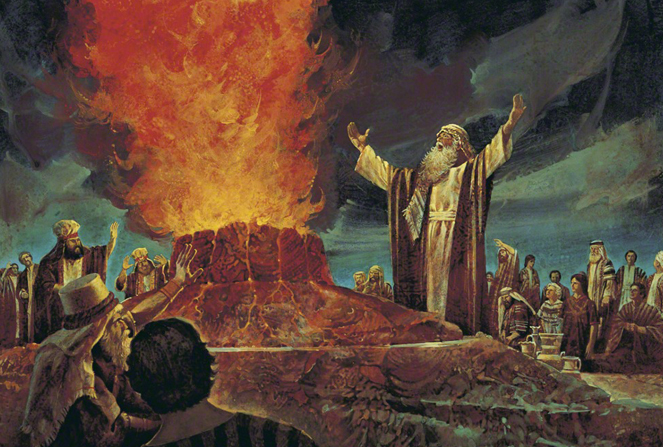
| From lds.org. Also, I know it's not the portrayal of the events I discuss, but it's all I've got. :) |
After Addra was born, I really struggled emotionally for
quite a long while. Looking back, I was probably (definitely) bordering on PPD
(if not officially over the border)—but I hid it well enough that I was sort of
getting by. In the wake of a new baby, I have felt like I need to do all I can
to be better off this time than last. So I’ve been perhaps more receptive than
usual to new interpretations of scriptures. It is in this state that I reread
the story of Elijah and the still, small voice last week. While the part that
we usually read is still beautiful and powerful, I was struck by the verses
before and after the famous story (in 1 Kings 19, if you’re reading along). I
don’t think this is any definitive interpretation of the story; it’s just the
one that makes sense to me right now. I think that’s the great thing about
stories and scripture stories in particular—they can reveal different things at
different times
In this time period, Elijah is struggling, depressed. He is in
hiding, his preaching has only earned him enemies, and he is watching the
people he loves destroy themselves by wickedness. So I suspect that when he
lies down and asks for death, he doesn’t do it lightly.
An angel comes and tells him to “arise and eat.” And sitting
before him, without any effort of his own, is food and drink. This is
especially poignant to me right now because after Koa was born, we were so
blessed for many days in a row to find food appearing repeatedly on our
doorstep, over and over, until our fridge could barely handle the leftovers.
Friends and ward members fed my family during a time when what we needed most
was rest and sustenance. We did nothing to receive it; it was a tiny but
beautiful miracle to us.
Elijah eats, drinks, and rests. Then the angel gives him
food and drink again because the journey set out before him is “too great.” And
Elijah eats and drinks and goes “in the strength of that meat forty days and
forty nights” until he gets to Horeb, to commune with God.
I love the beauty of this—Elijah is sustained in his long
journey, his struggle. Doesn’t the journey sometimes seem very, very long? But
are we not sometimes sustained in that journey by gifts freely given?
So when Elijah arrives at a cave at Horeb, the Lord asks him
what he’s doing there, and this is Elijah’s response:
“I have been very jealous for the Lord God of hosts: for the
children of Israel have forsaken thy covenant, thrown down thine altars, and
slain thy prophets with the sword; and I, even I only, am left; and they seek
my life, to take it away.” (v. 10)
To me, this feels exhausted, lonely, perhaps questioning his
mission: “What’s the point? Nothing I’ve done has made a difference.”
And then he experiences all those powerful events—a wind, an
earthquake, a fire. Then the voice, still and small, the only thing that the
Lord was in. I can’t help feeling like all of this was just another piece to a
process that had already begun with the moment he wished for death. Elijah had
been supported, strengthened, and now shown that powerful manifestations aren’t
necessary to feeling the help and love of the Lord.
But this is not the end of the story. The scripture explains
that Elijah gets up after he hears the voice, and he goes to stand in the
entrance to the cave. When a voice asks him again what he’s doing, he answers
almost exactly the same thing as he’d said before. In other words, Elijah
recognizes that his physical circumstances remain unchanged. The manifestations
from the Spirit do not suddenly soften the hearts of those who hunt him; they
do not resurrect dead prophets and friends; they do not convert the children of
Israel.
What did all of this do, then? It strengthened him, it
changed his heart. The Lord gives him instructions on what to do next, and
here’s what the scripture says, simply, about his reaction: “So he
departed thence.”
I hope that simple statement of obedience can someday be
said of me.

Thanks for sharing Jeanna -- having kids is hard -- I can only imagine how hard it has to be for women, who actually get all the hormone imbalances and all the other fun stuff that comes along with having a kid. Sounds like you're more conscious of some of that stuff this time around, hopefully that makes it a bit easier. Seems like you're sort of saying that if I got it right :)
ReplyDelete